
How Do Home Service Businesses Get Cited by ChatGPT and Google's AI Answers in 2026?
Getting On Camera Is The Competitive Advantage Hiding Right Under Your Nose.

November 5th, 2026

Jaden Galinato
The best way for a home service business to get cited by AI is to publish Q&A-style content that answers real customer questions, in your own words, with your own expertise behind every answer. AI tools build their answers from pages that answer the question clearly and add something other pages can't. And here's the good news: you already answer these questions every single day, on the phone and on job sites. You just haven't written them down yet. Doing this allows you to get cited over your competitors, gets more eyes on you, and leads to more booked jobs.
In a previous post, we covered why AI visibility is the next big marketing channel for contractors. This post is the how.
Table of Contents:
Customers are now asking full questions into Google and AI platforms. While "roofer near me," still gets searches, "Should I repair or replace a 20-year-old roof after a hailstorm?" type searches are now more common than ever thanks to AI overviews.
Google said it themselves. In its AI search experiences, users are asking longer and more specific questions, plus follow-up questions to dig deeper. And those AI answers keep people from clicking around. Pew Research found that when Google showed an AI summary, users clicked a regular search result in just 8% of visits, compared to 15% when there was no summary.
So if you have content like a blog or an Instagram reel that answers a frequently asked question, that could be a reference in an AI overview. And if you already know about SEO, that top of page real estate means everything.
How Are Customers Finding Home Service Businesses Now?
What Does It Mean to Get Cited by AI?
Getting cited by AI means ChatGPT, Google's AI Overviews, or another AI tool uses your website as a source when it answers someone's question, and often names or links your business in the answer.
Think of AI like a new office manager who reads your website before answering a customer's call. If your site clearly answers the question, they repeat your answer (and your name). If it doesn't, they find someone else's site that does. Usually your competitor's.
Being the cited source puts your business right inside the answer, where homeowners are already looking. We broke down how this started reshaping Google in AI Overview Just Changed SEO.
Why Does Getting Cited by AI Even Matter for Contractors?
Getting cited by AI matters because AI tools usually name only a few businesses in their answer, and the homeowners asking are often close to hiring someone. If your business is on that short list, you’re competing against a couple of companies instead of a full page of Google results.
And homeowners trust those answers more every year. A 2026 consumer survey found that 41% of people trust AI recommendations for local services as much as or more than a personal referral, up from just 12% in 2024. Another report found that 78% of homeowners have made a purchase based on an AI recommendation.
Think about what that means. AI is becoming the new word of mouth. A cited answer works like a neighbor telling a homeowner “call these guys,” except it happens over and over, every day, to homeowners you’ve never met. (We covered what happens when contractors rely on old-school referrals for too long in this post.)
Some of our clients have already starting getting leads by getting referred directly from ChatGPT.
Why Do AI Tools Pull From Q&A-Style Content?
AI tools pull from Q&A-style content because it matches how people ask, and because the best Q&A content contains things AI can't make up on its own: real prices, real examples, and real experience.
Google's own guide on optimizing for its AI features calls this non-commodity content. Its example of commodity content is a generic post like "7 Tips for First-Time Homebuyers," while non-commodity content gives a unique expert or experienced take that goes beyond common knowledge. Ex: “7 Tips That All First-Time Homebuyers Should Know Before Buying An 1980’s Home In Sacramento, California”
That's the whole game for home service businesses. A generic "5 Signs You Need a New Roof" post sounds like every other roofer's website (and, honestly, like something AI could write itself). A post where the owner explains what he actually sees on 25-year-old roofs in his specific town? Nobody else has that. That's what gets cited.
Which leads us into our next question…
What Makes a Good Answer That Will Get Cited by AI?
A good answer gives the answer in the first sentence, backs it up right away, and adds something only your business knows, or is relevant to your local area. Simple as that.
Here's the difference:
Weak: "Roof replacement costs vary depending on many factors."
Strong: "Most roof replacements we do in Tampa Bay land between $12,000 and $30,000. The biggest swing is whether the decking underneath needs to be replaced, which we find on about 7 out of 10 older homes."
The strong version answers the question, gives a real number, and includes first-hand experience. It's written the way you'd explain it to a homeowner standing in their driveway. That's exactly the kind of answer AI tools want to quote.
To Make This Easier To Remember: Your Content Needs FACTS.
F – First sentence answers the question.
A – Actual numbers.
C – Close to home (local details).
T – Tell from experience.
How Do Your Videos Become Content AI Can Cite?
Your videos, whether on Youtube, Instagram, or Facebook, etc. become citable content when they answer common questions from your customers.
The kicker? Video pulls double duty here. Pew found YouTube is one of the sites Google's AI summaries link to most, right alongside Wikipedia and Reddit. One day of filming can turn into months of content, and every piece of it sounds like you, because it is you.
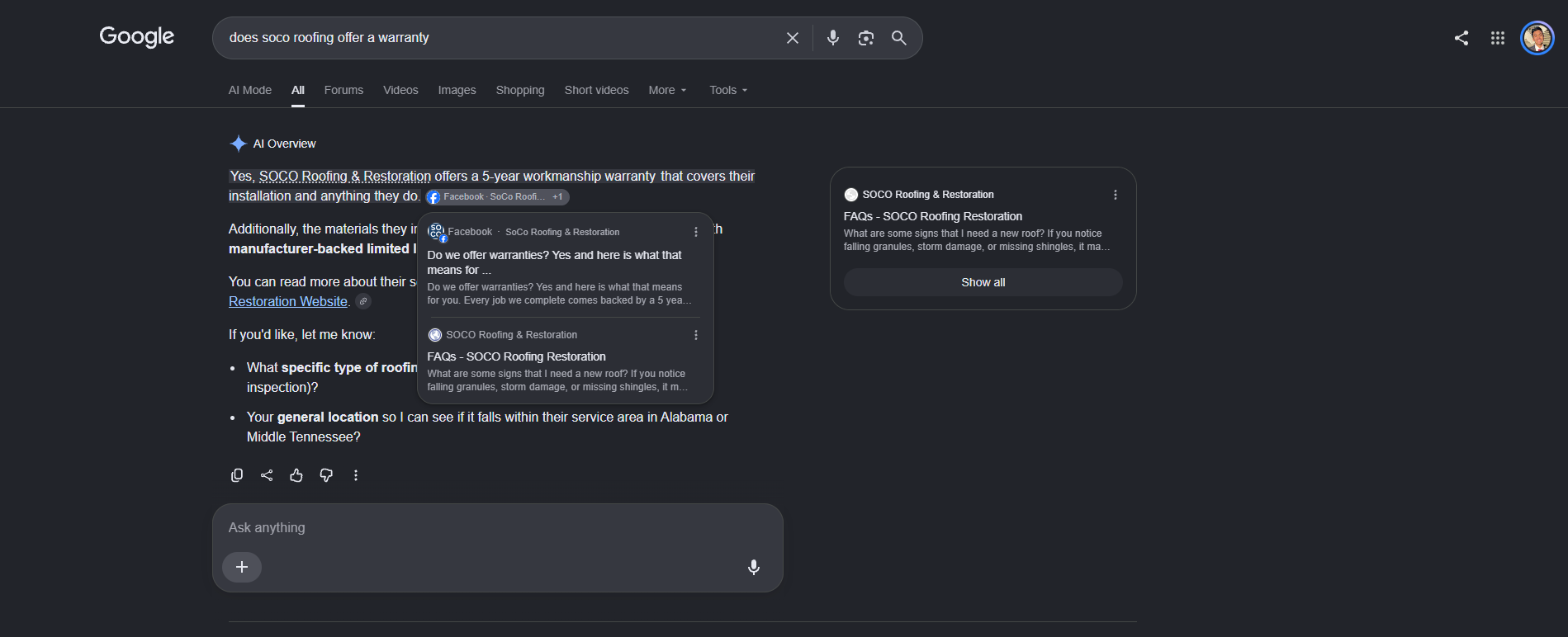
Here’s a prime example. A search query like “Does SOCO roofing offer a warranty?” cites a Facebook reel answering this exact question in the AI overview. Yes, your customers are asking specific questions like this in Google. Why? They don’t want to have to scan your entire site just to find this answer.
Which Questions Should Your Business Answer First?
Start with the questions customers ask before they hire you. These are the ones AI gets asked most, and the ones that bring in serious buyers.
Cost questions: "How much does ___ cost in [city]?"
Comparison questions: "Is ___ or ___ better for my home?"
Timing questions: "When's the best time to ___?"
Should-I questions: "Should I repair or replace my ___?"
Process questions: "What happens during a ___ inspection?"
Next time you answer one of these on the phone or during an initial consultation, record a quick voice memo on the drive back. That's a blog section and social media profile in the making.
Start a List of the Questions Your Customers Ask Every Week
The businesses AI tools cite most are the ones with the best answers, and nobody can answer your customers' questions better than you, because you've already been answering them for years. Write down the questions you hear every week, and you've got the start of a content plan that ChatGPT and Google will actually start pushing out to your potential customers.
When you want help turning those answers into content, that's what we do. On a free strategy call, a Grandir Solutions team member will check how your business currently shows up in AI search, pinpoint the customer questions your competitors are already getting credit for, and map out a Q&A content plan built around your own expertise, including whether a content trip makes sense for your business.
About the Author
Jaden Galinato is a Digital Marketing Associate at Grandir Solutions, where he's led content production, email marketing, and Google Ads for home service and construction businesses since March 2024. He’s written and manages recurring blog and newsletters for 83 contractors (and counting) across North America, from roofers and gutter companies to remodelers and painters, with a focus on content built to rank on Google and get cited by AI.